

THE BUG LADY
ALL PRODUCTS
**All prices are listed in Canadian dollars and subject to freight charges
plus HST or GST/PST, depending on your province.**
Products marked with the symbol must be ordered by 2:00 PST on Fridays for shipping Monday,
and 2:00 PST on Tuesday for shipping Wednesday. Place an order by contacting us!

You can get discounts on products by ordering them in COMBO PACKS! See individual pest pages for more info: Aphids | Spider Mites | Thrips and Fungus Gnats
OUT OF STOCK
250 Bag: (22729) $25.00 Suited for 50 - 200 square feet.
1,000 Bag: (22731) $50.00 Suited for 200- 500 square feet.
3,000 Bag: (22730) $95.00 Suited for 500 - 1,500 square feet.

Anystis Baccarum:
50 Mites (22680): $62.50
250 Mites (22685): $172.50
Check out our individual pest page to see our combo packs!

Buy Ladybugs + Aphidoletes together and get a discount on the Ladybugs.
NEW - discount on Ladybugs when purchased with Anystis.
More info here!
Praying Mantis:
CURRENTLY AVAILABLE!
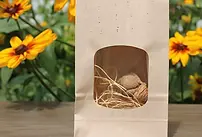
3 oz Bag: $20.00 (22728)
Buy with a bag of ladybugs and get the food for $17.00.
Suited for up to 1500 square feet.
Having ladybugs and other beneficial insects in your yard is wonderful, but it can be a challenge to keep them. Using a food source can be a great way to hold on to your beneficial insects like ladybugs and lacewings and direct them to certain areas of your yard. Ladybugs in particular require a liquid food source when released; it will increase their egg laying and your control.

25 pack Bio Boxes: $14.75 (23819)
small boxes, designed with a hook to hang from plants, providing a safe spot from which the beneficial insects can disperse easily. Allows for a cleaner distribution.

1,000 Green Lacewing Eggs (23742): $15.00
(buy 3 or more: $12.00/ 1,000)
1,000 Green Lacewing Larvae (23740): $80.00

Set of 25 cards: $12.00 (22777)
Add on to any order and get it for $5
Each card featuring info about different pests and beneficial bugs in the garden.
A pocket guide to discovering bugs in the garden. Ideal for the backyard gardener, garden centre employees, and gifts!

Aphidoletes:
Aphidoletes are a predator midge of aphids.
They're shipped out in the pupal stage. After sitting at room temperature for a few days, you'll see the adult midges flying around in their container. Once that happens, they are ready for you to release them to start hunting aphids. Can be used with ladybugs. Read more...
Are you tired of dealing with sticky honeydew from aphid-infested boulevard trees?
This is your solution:
Hang vials of Aphidoletes from every tree (every other tree if trees are adjacent) and the Aphidoletes will emerge directly from the vials without you having to do anything!

Aphidoletes
250 tray (22710): $37.50
suited for areas up to 2,000-5,000 square feet
1,000 tray (22715): $82.50
suited for areas up to 5,000-20,000 sq. feet
250 Aphidoletes - hanger (22711): $42.50
Buy 3 or more: $38.00 each

Brown Lacewings (Micromus variegatus)
Prevention Rate: 600 adults per hectare in spring.
Reactive Rate: 100 to 200 adults in a hotspot, once. Eggs are best for hot spot knock-down.
50 adults (or 100 eggs on strings): $85.00 (22732/22734)
100 adults : $125.00 (22733)


Mighty Mites (Phytoseiulus persimilis):
Persimilis is the only species of mite that will actually go into webbing to feed on spider mites and get your pest problem under control. It is the best, but also fussy: it needs relatively high humidity (60%) and is not at all compatible with pesticides
1,000 Mites (22750): $56.00 on vermiculite (for areas ~500 square feet)
Buy 3 or more: $40.00
2,000 Mites (22751): $76.00 on vermiculite - smaller "hot spot" vial (for areas ~500-1000 sq. feet)
Buy 3 or more: $60.00
(Ordering Tip: it is better to buy 1 bottle of P.p. per room,
as it is almost impossible to divide up a bottle evenly between separate growing areas)
Hot Mites (N. fallacis):
It's never a bad idea to introduce fallacis alongside persimilis. This mite will stick around and feed on pollen while preventing spider mites from re-establishing. They're a one-time introduction, and will feed on a variety of pest mites. They can be used indoors and outdoors, on conifer hedges, berries, and bamboo, for example.
You can divide up the fallacis between different rooms, which you cannot do with persimilis.
500 Mites (22701): $29.50 on vermiculite. For areas up to 2500 sq. feet
1,000 Mites (22702): $39.75 on vermiculite. For areas up to 5000 sq. feet
5,000 Mites (22703): $105.00 (bag) on vermiculite, For areas 10-20,000 sq. feet
Click here for our spider mite combo packs to get products at a discounted rate.
Stethorus (Stethorus punctillum):
Stethorus are meant to be used as "hot spot" treatment, alongside the mite predators above. They are expensive to rear (and for you to purchase), so realistically are to be used as a supplement. They will fly freely to find new mite spots.
50 Stethorus Beetles (22763): $82.75
100 Stethorus Beetles (22764): $121.75

Pictured: Spider Mite Products: Anystis, Persimilis, Fallacis.
Hype-O (Stratiolaelaps scimitus):
Hypoaspis are soil mites, and will live in the soil for the life of your plants. They are a one-time application, and feed on fungus gnat eggs and larvae, thrips pupae, springtails. They are also recommended to be put out as an additional measure of spider mite control. Read more...
3,000 Mites (22742): $19.00 suited for areas up to 200 square feet
1L tube (25,000 mites) (22740): $45.00 suited for areas 1,000-2,000 square feet
Buy 3 or more: $35.00/1L

No-Thrips (Neoseiulus cucumeris):
Cucumeris are mites that are applied to the foliage of your plants, and will feed on immature thrips larvae found on the surface of your leaves. Cucumeris can be applied every 4-6 weeks to help control thrips numbers. Read more...
10,000 Mites (22690): $25.00 cover up to 500 sq. feet of foliage
1L pouch (50,000 mites) (22700): $45.00 suited for areas 1,000-2,000 sq. feet
Buy 3 or more: $35.00/1L
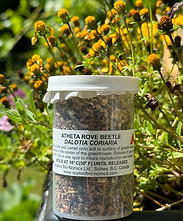
Rove Beetle (Dalotia coriaria):
Rove Beetles (Atheta) are generalists that do very well in moist conditions. They're best introduced alongside Hypoaspis, as they take a bit longer to establish. They will feed on mainly fungus gnat & shore fly larvae.
100 Beetles (22712): $32.50 suited for areas up to 1,000 feet
1,000 Beetles in 1L tube (22713): $135.00 suited for areas 5,000 to 10,000 feet
Yellow sticky cards (for monitoring and trapping)
Yellow sticky cards are used to monitor and trap whitefly, adult thrips, and adult fungus gnats. Read more...
Pack of 10 (10 x 25 cm ea.) (23800): $15.00
Pack of 100 (10 x 12.5 cm ea.) (23795): $65.00
Entonem (Steinernema feltiae):
50 million (25251): $56.00 suited for areas of 550 to 1,650 square feet
Buy 3 or more: $51.00

Encarsia (Encarsia formosa):
Encarsia are tiny parasitic wasps that are sold on cards to hang directly on your plants. They are excellent searchers, and both feed on and parasitize immature whitefly pupae. We recommend that you re-apply the strips every two weeks, at least 2-3 times, to break the whitefly life cycle. Read more...
Strips of 1,000 (100/card) (22725): $22.50 for areas of 1,000-10,000 square feet
(Buy 3 or more: $15.00)
Pictured above: Close up of the Encarsia strip, with the immature pupae in the circular window, out of which adult wasps will emerge.

Delphastus (Delphastus catalinae)
100 Delphastus Vial: $55.00 (22722)
Prevention Rate: 200 per acre every two weeks
Reactive Rate: 100 per hot spot or 10 per infected plant.
Cryptolaemus
Looking for crypts (mealy bug predators)? We bring them in twice a month in bulk, to package and ship. Shoot us an email inquiry to check our availability and get on the pre-order list!
50 beetles (22719): $47.50
covers up to 40 12" pots/ 450 square feet
100 beetles (22720): $77.50
covers up to 100 12" pots/ 700 sq. feet
Rhyzobius
Used on armoured and soft scale insects. Small scales are consumed entirely. In larger scales, feeding damage is visible as irregular holes in the scale cover.
Light infestations, 3-5 predators per plant.
Heavier infestations, 10 predators per plant.
50 beetles (23719): $47.50
100 beetles (23720): $77.50
500 beetles (23721): $325.00
We bring them in twice a month in bulk, to package and ship.
Shoot us an email inquiry to check our availability and get on the pre-order list!
Attack Pack (Steinernema carpocapsae) (25503):
This is the nematode you want for your vegetable garden if you're battling cutworm, root worms, asparagus beetle, cranefly, fleas, flea beetle, and more! Apply April-late summer. ***Only effective on the larval stage of each pest. Check the soil and life cycle of the pest in your area before applying.***
6 million: $42.00 suited for areas ~500 sq. feet
Nemalawn (Steinernema carpocapsae) (25502):
Takes care of sod web worm, cranefly, and fleas in your lawn! Apply May-October. ***Only effective on the larval stage of each pest. Check the soil and life cycle of the pest in your area before applying.***
6 million: $42.00 suited for areas ~1000 sq. feet
Weevilution (Heterorhabditis bacteriophora) (25501):
This popular weevil-controlling nematode has a particular application time, as it's only effective when applied if daytime soil temperatures reach 12 C. Those application windows are April through mid-May, and then again September through mid-October.
6 million: $42.00 suited for areas ~500 sq. feet
Ready to Order?
Contact Us!
Cold Shots (Steinernema kraussei) (25500):
This nematode is the head start you need on weevil control. Apply it before your first application of weevilution. They start to work once the soil temperature is 6 C.
Check in during early March to see if temperatures are right for the first application!
6 million: $42.00 suited for areas ~500 sq. feet
Entonem (Steinernema feltiae) (25251):
This is the nematode you want as a soil-drench treatment for both fungus gnat larvae and thrips pupae . It can also be used as a foliar spray to control adult thrips if you're able to keep your plants wet for an extended period of time.
For more info, see the Fungus Gnat & Thrips Control page
50 million: $56.00 suited for areas of 550 to 1,650 square feet
Buy 3 or more: $51.00
Seasonal:
For info about seasonal products such as praying mantis and nematodes, for weevil and chafer beetle control, check out our Beneficial nematode page, or our Weevil and White Grub page.
Wholesale Services
Looking for bigger quantities, a larger list of products, and wholesale selection for greenhouse/store use?
Please email thebuglady@westgrowbios.ca with some details regarding what you're looking for and we'd be happy to put together a quote for you!
Combo Packs
Introducing Combo Packs!
Now you can purchase sets of a variety of biologicals, each suited to a particular pest.
Check the bottom of the thrip, aphid, and spider mite pages for details on how to save on different beneficials as you tackle your pest problem.